Multispectral
Overview
Multispectral imaging consists of capturing four individual specific bands of the electromagnetic spectrum, namely green, red edge, red and near infrared. Data captured in these discreet bands is analysed and compared to generate index maps to assess plant health, soil fertility, pests, vegetation damage, soil moisture and much more.
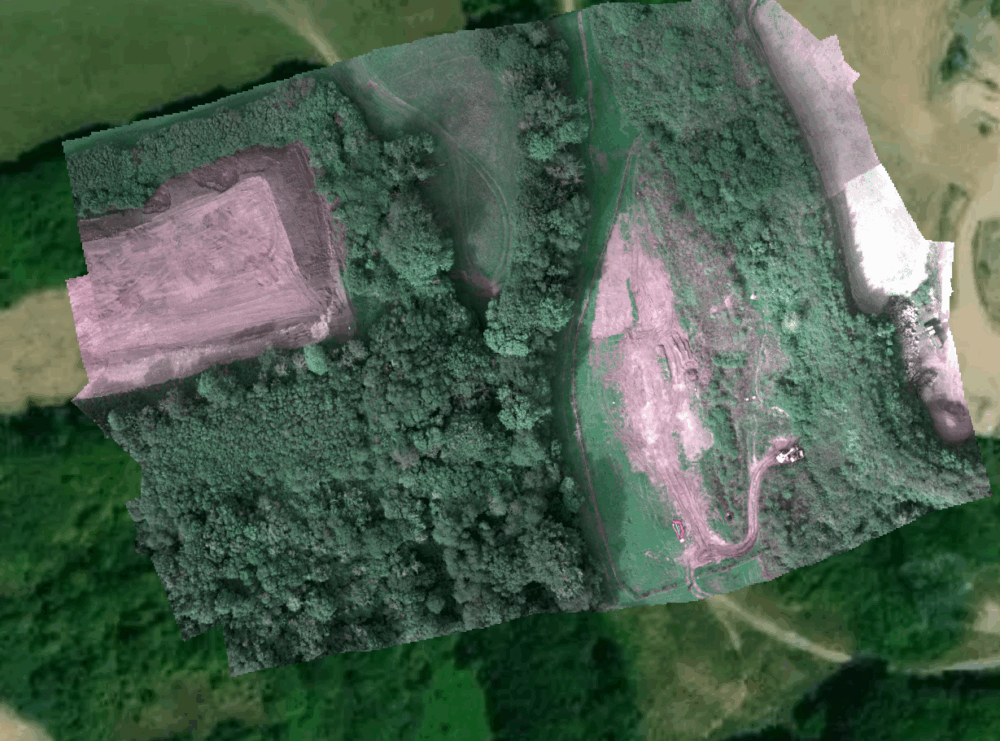
How does it work?
The health of plants can be used as a proxy for what lies below. Individual plants will grow differently in compacted soil, or differing levels of moisture. We can use these differences in plants to derive information across a number of sectors. For example:
- Detection of dying or dangerous trees. Dangerous trees are geolocated for further inspection. Geospatial data captured can be used to plan forestry operations for the removal of dangerous trees that may threaten public safety, transport or utilities.
- UAV multispectral surveys can be used to indicate soil moisture levels. This can help identify leaks in water pipes that cross under vegetated surfaces such as fields.
- Plants growing above an archaeological feature will grow differently from the surrounding plants due to the previous disturbance of the soil.
- Areas of poor crop performance can be identified and targeted applications of water, fertiliser and pesticide applied accordingly. This reduces waste of materials and the environmental impact of commercial crop production.
Benefits and Applications:
- Crop monitoring, crop counting and crop health.
- Prescriptive maps for fertiliser or insecticide for targeted application
- Forestry canopy health
- Archaeological surveys.
- Detection of dying and dangerous trees for protection of public areas, highways, railway & utilities
Service Provision
At Glanville Geospatial, we provide cutting-edge multispectral services that deliver actionable insights across sectors such as agronomy, utilities, and environmental monitoring. By combining drone technology with advanced sensors, we help you see beyond the visible spectrum.
Vegetation Condition Monitoring & Assessments
Firstly, our multispectral imaging allows for accurate vegetation condition monitoring, helping landowners, councils, and environmental consultants assess plant health, detect stress, and plan timely interventions. In addition, our data supports sustainable land management and biodiversity protection.
Hazardous Trees & Ash Dieback Detection
Moreover, we specialise in identifying hazardous trees and detecting ash dieback early. This enables proactive tree management, reducing risks to infrastructure and public safety. As a result, you can make informed decisions before problems escalate.
Utility Infrastructure & Leak Detection
Meanwhile, our multispectral surveys are invaluable for utility providers. We help detect leaking pipes and underground faults that are invisible to the naked eye. Consequently, this leads to faster repairs, reduced water loss, and improved service reliability.
Agronomy & Crop Health Insights
Furthermore, our services support precision agriculture through detailed analysis tailored for agronomy. We help farmers and agronomists monitor crop health, optimise inputs, and improve yields. Ultimately, this means better productivity and resource efficiency.
Why Choose Glanville Geospatial?
- High-resolution multispectral data
- Expert interpretation and reporting
- Integration with GIS and asset management systems
- Proven results across environmental and infrastructure sectors